Transitioning Your Palate: Moving to High-Proof Pours for Fall
Learn how to use proof as a dial rather than a test. Build a fall-ready tasting progression from approachable wheated bourbons to port-finished cask strength releases.
On This Page
Got a tip? Know about an upcoming release, a shelf find, or industry news worth covering? Send it our way. We read every submission.
Crisp autumn evenings naturally shift our preferences toward pours with more weight and warmth. Many drinkers assume higher proof automatically equals higher quality or sharper burn. Proof is actually a dial rather than a test of bravado. Finding the exact point where a whiskey opens up to your palate transforms how you taste. Note that readers must be 21 and older to purchase alcohol and should always drink responsibly.
The Anatomy of Proof
Federal regulations set clear boundaries for bourbon production. A distiller must use a fermented mash of at least 51 percent corn, distill the spirit at 160 proof or less, and store it in charred new oak barrels at 125 proof or less. The absolute minimum bottling strength is 80 proof.1 Everything above that floor represents a choice by the producer. Voluntary cask-strength releases deliver the whiskey exactly as it exited the barrel.
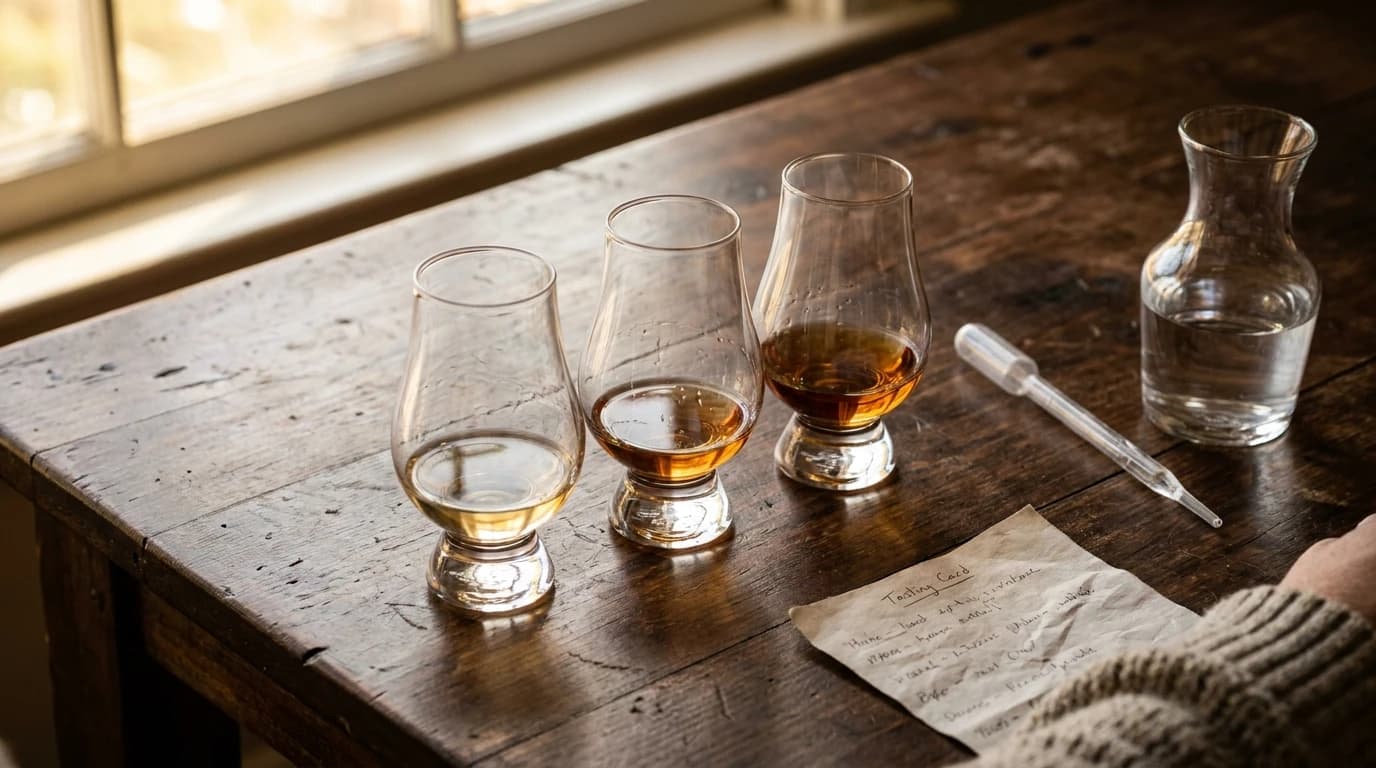
Calibration begins with a controlled pour. High ethanol concentrations can overwhelm sensory receptors and mask nuanced aromas. A practical method involves starting with a known two-ounce measure and adding small amounts of water until the taste suits your preference.2 Calculating the resulting proof allows you to compare different whiskies on equal footing and reveals your personal sweet spot. Water lowers the alcohol concentration, releasing aromatic oils and softening the initial heat.
The Soft Landing: Wheated Bourbon
Wheat provides a softer texture than rye, making it an ideal starting point for a high-proof progression. The grain highlights caramel and vanilla notes without the sharp spice that can amplify perceived heat. A current benchmark for this style is Maker%27s Mark Cask Strength Batch 26-01.
This release arrives at 109.4 proof with a stated age of seven years and one month.3 The mash bill uses 70 percent corn, 16 percent red winter wheat, and 14 percent malted barley.3 At a 2026 suggested retail price of $50 per 750 milliliter bottle, it offers an accessible way to explore unproofed whiskey.3
Maker's Mark Cask Strength Batch 26-01
109.4Suits: Learning to calibrate proof
A soft, rounded entry point into cask-strength pours.
Explore in Digital Dram catalogRecord Your Perfect Proof
Open Tasting NotesThe Traditional Core: Rye-Forward Mash Bills
Rye introduces baking spice, black pepper, and structural firmness. Moving up the proof ladder, Pinhook 2026 Cask Strength Bourbon serves as a prime learning vehicle. Distilled at Castle & Key, the original Old Taylor Distillery, this five-year Kentucky straight bourbon lands at 115.9 proof.4 It features a recipe of 75 percent corn, 15 percent rye, and 10 percent malted barley, carrying a $54.99 suggested retail price.4 It represents an intentional, everyday bottle perfect for experimenting with water drops.
Pinhook 2026 Cask Strength Bourbon
115.9Suits: Everyday palate training
An excellent rye-forward profile for testing dilution levels.
Explore in Digital Dram catalogOther familiar expressions share this proof neighborhood. Wild Turkey Rare Breed blends six-, eight-, and twelve-year bourbons into a 116.8-proof release utilizing 75 percent corn, 13 percent rye, and 12 percent malted barley.5 Similarly, Old Forester 1920 Prohibition Style from the Brown-Forman Shively Distillery sits at 115 proof with 72 percent corn, 18 percent rye, and 10 percent malted barley.6
The Finished Summit
Secondary maturation in distinct casks can wrap high-proof heat in layers of dark fruit and caramelized sugars. The residual sweetness from a finishing barrel interacts uniquely with high alcohol content.
The latest iteration from a recognized series is the Angel%27s Envy 2026 Cask Strength Bourbon. This fifteenth-edition release registers at 117.8 proof.7 It utilizes a Solera-inspired blend double matured for up to three years in Ruby Port barrels.7 Priced at $249.99 per 750 milliliters, the nationwide allocation includes approximately 20,640 bottles.7 Finished high-proof bourbons often require different water additions than traditional counterparts because the port-derived sugars shift the balance of the spirit when diluted.
Finding Your Level
Mastering high-proof bourbon requires patience and a willingness to experiment. A drinker who identifies the exact point a pour becomes enjoyable gains a portable skill for every future bottle. Treat water as a tool for unlocking flavor, record your findings, and build a fall lineup that suits your exact palate.
Footnotes
-
27 CFR § 5.143, Whisky, eCFR / Alcohol and Tobacco Tax and Trade Bureau, 2026-08-14 ↩
-
Here's Exactly How Much Water to Put in Your Whisky, Whisky Advocate, 2017-09-28 ↩
-
Maker's Mark Cask Strength (Batch 26-01), Breaking Bourbon, 2026-07-22 ↩ ↩2 ↩3
-
Pinhook 2026 Cask Strength Bourbon Sell Sheet, Pinhook Bourbon, 2026-04-03 ↩ ↩2
-
Wild Turkey Rare Breed Bourbon (116.8 Proof), Breaking Bourbon, 2021-08-20 ↩
-
Old Forester 1920 Prohibition Style Bourbon, Breaking Bourbon, 2017-06-01 ↩
-
Angel's Envy Debuts 2026 Cask Strength Dual Release Featuring Annual Bourbon and First-Ever Age-Stated Rye, Angel's Envy / PR Newswire, 2026-03-31 ↩ ↩2 ↩3